Event: ETSI ZSM PoC 16 webinar
Date: November 14, 2025
Location: Webinar (organized by ETSI ZSM)
Participant organizations: UBI, UoP, PNET, NOVA, K3Y, CTTC, WINGS, LMI, TID, UPM
Presenters: Georgios P. Katsikas (UBI), Kostis Trantzas (UoP), Lluis Gifre (CTTC), Dimitrios Triantafyllou (WINGS)
Projects: ACROSS HEU and COP-PILOT
What happened in this webinar?
A consortium of partners from the ACROSS and COP-PILOT projects appeared in this event with a proof-of-concept demonstration that showcases how an open orchestration platform extends across multiple private administrative domains and organizations to automatically provision compute, network, and service components while maintaining service levels, security, and trust.
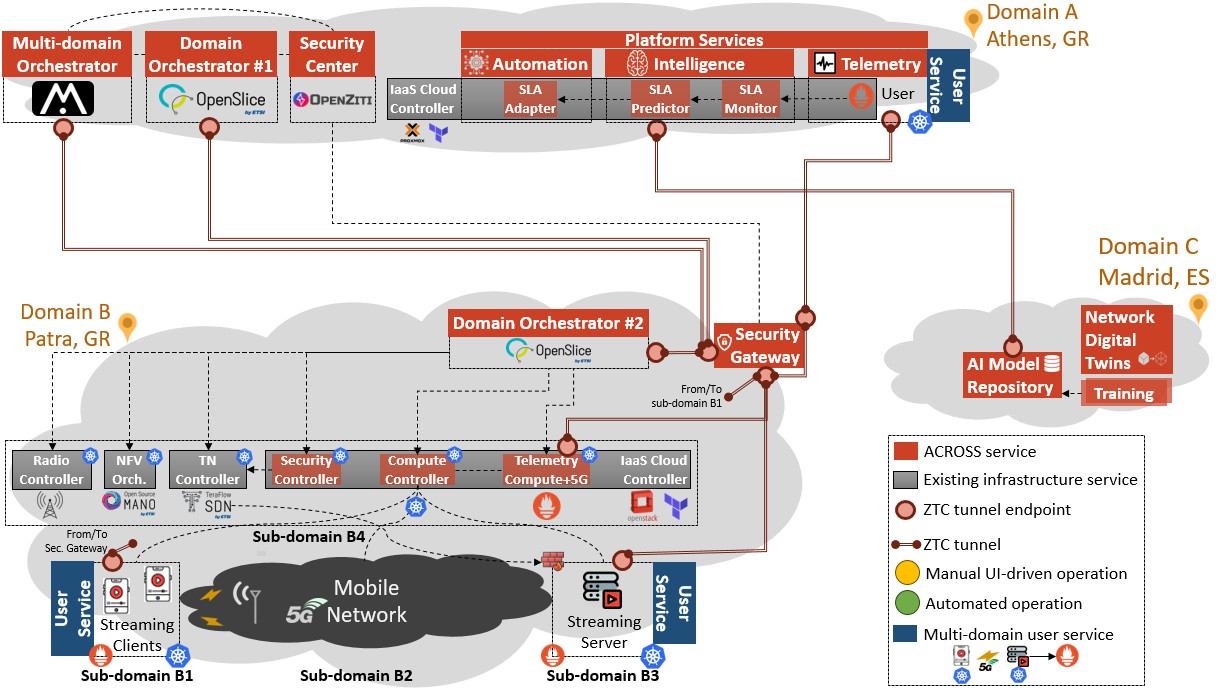
The event started with an introduction on why joint service and network orchestration is crucial, especially in modern multi-domain environments which pose strict requirements in terms of security, trust, privacy, but also management of heterogeneous resources and services. Then, the presenters emphasized the objective of this PoC and highlighted the testbeds that were used to conduct this PoC demonstration. Three testbeds were used in Athens, Patra (Greece), and Madrid (Spain), with UBITECH, UOP/PNET, and TID being the testbed owners. Next, the presenters demonstrated the setup of the entire system across these 3 testbeds, emphasizing the available hardware and platform components in every testbed. Finally, the presenters unfolded 4 scenarios, each focusing on a different aspect:
- Scenario #1: The owner of a new private domain in Patra (Greece) becomes a new customer of the orchestration platform and wishes to add this domain under the platform’s realm for enabling business to local stakeholders in the city of Patras. This scenario shows how a set of simple steps guided by a user portal allow this private domain to become part of a large platform, thus offering IT (edge cloud and 5G) services to local customers in the city of Patras.
- Scenario #2: A new customer in the newly onboarded Patras domain wants to deploy a 5G video streaming service across different sub-domains. The platform offers nice service bundles that allow this service to be deployed almost in a fully automated manner, despite the complexity of the underlying setup. This scenario shows can such a complex service can be materialized in a few minutes.
- Scenario #3A: After the service gets deployed, the service owner desires to increase the runtime security of certain service components, to fortify the service and its users from potentially malicious attacks. The platform offers a service tailored to the needs of the customer, which gets deployed in a blink of an eye.
- Scenario #3B: The service owner now appears with a performance requirement for the 5G video streaming service. The platform allows the service owner to express this requirement as a formal Service Level Agreement (SLA), offering a predictive approach to meet this SLA. A closed loop is demonstrated between the central domain in Athens and the edge domain in Patras, where a smart Analytics model exploits service telemetry to forecast potential SLA violations, thus proactively notifying the orchestrators to adapt the service in time, before the SLA gets violated.
In all four scenarios, the PoC demonstrates not only the ability to achieve the objectives but also achieves substantial amount of automation (64-86% of all steps were fully automated) in complex operations that are now greatly simplified by the platform.
What was proposed in this webinar?
A multi-component system – based on open-source components – that allows telco operators, (edge) cloud providers, large industries, and stakeholders across different business sectors to collaboratively offer modern types of services using: (i) standardized TMForum APIs (adopted by the industry today) and (ii) a user-friendly portal that realizes critical user operations with a high degree of automation, increased security, and zero-trust among the participating parties. The operations demonstrated in this PoC cover:
- The registration of a new private domain under the platform, showing how quickly an orchestration platform expands towards private infrastructures and new stakeholder environments in a secure and trusted manner.
- The end-to-end provisioning of compute, network (5G), telemetry, and end user services in a private edge domain in a fully automated way.
- The runtime protection of a modern service with on-demand security as a service.
- The proactive SLA preservation of a modern service through Analytics training and Inference and an automation service that closed the loop via standardized service update APIs.
What was adopted/or what will be considered by ETSI?
Three ETSI open-source platforms, namely ETSI OpenSlice (acting as a domain orchestrator), ETSI Open Source MANO (acting as an NFV Orchestrator), and ETSI TeraFlowSDN (acting as a transport network SDN controller) as well as a new ETSI OpenSlice MDG titled Maestro, were employed to orchestrate the entire PoC. These platforms demonstrated: strict conformance to:
- TMForum APIs at the resource (TMF 634, 652, and 639 APIs), service (TMF 633, 641, and 638 APIs), performance (TMF 628), and SLA (TMF 623 API) management levels,
- adoption of ETSI NFV SOL005 API for NFV management,
- ETSI ZSM architecture as per ETSI ZSM 002,
- end-to-end management of network slicing as per ETSI ZSM 003,
- cross-domain end-to-end service lifecycle management as per ETSI ZSM 008,
- network digital twins for network management as per ETSI ZSM 018 specifications, and
- 3GPP rel. 17 specifications for the demonstrated end-to-end 5G deployment.
This PoC proves the dedication of ETSI Software Development Groups to developing open standards across multiple SDOs for delivering a holistic platform for 6G in near future.
Scenario #1 business value
Scenario #1 demonstration is a proof on how easy it is to onboard new stakeholders (i.e., customers) in a modern service orchestration platform through a set of simple steps. If you want to offer resources from your private testbed to an orchestrator, you no longer need to worry about VPNs and time-consuming infrastructure onboarding processes. We have greatly simplified things for you. And the most important: we register your private resources on the platform with ultimate levels of security (every packet is encrypted) and zero-trust.
Scenario #2 business value
Scenario #2 demonstration shows how powerful the marketplace of a modern orchestration platform is. We dismantled the essential components of a complex 5G video streaming service and put them together into a service bundle that allows service providers to employ such a complex service with a simple click through the orchestration portal. Upon the user’s service order, the platform undertakes to allocate (i) compute and 5G resources, (ii) video streaming service components, and (iii) end-to-end telemetry services in a truly zero-touch manner.
Scenario #3A business value
Scenario #3A demonstrates how easy it is to add security add-ons to a running service without interrupting the service and with zero low level configuration. A modern orchestration platform offers security as a service, which can be ordered and realized in a matter of seconds through the synergy of service orchestration, a security and network controller. Such a service is crucial in today’s digital world, with thousands of cyber-attacks threatening public and private infrastructures every minute.
Scenario #3B business value
Scenario #3B demonstrates a key aspect of modern services in the telco landscape: i.e., how a telco operator’s platform meets a Service-Level Agreement (SLA) between the operator and the customer in a proactive fashion. Specifically, we demonstrate how the platform leverages the latest advancements in AI to forecast potential SLA violations and schedule remedy actions for a service to ensure its SLA never gets violated. This is so crucial for a telco operator as it both prevents capital loss for compensating violated SLAs and keeps customers happy, potentially attracting more in the future.
Related material
 The ZSM PoC proposal document is available here: ZSM-PoC-Proposal-ACROSS
 The ZSM PoC proposal presentation, presented at the ETSI ZSM #32 Plenary Meeting (September 9, 2025), is available here: ZSM-PoC-Proposal-ACROSS
- The ZSM PoC demo presentation, presented during the ETSI ZSM PoC 16 Webinar (November 14, 2025), is available here: ZSM-PoC-Demo-ACROSS
 The ZSM PoC dissemination material is available here: i) Demonstration videos – ACROSS YouTube playlist featuring ETSI ZSM PoC 16 demonstrations, ii) Presentation screenshots & acknowledgements
- The ZSM PoC final report, delivered to ETSI ZSM to conclude the PoC, is available here: ZSM-PoC-Report-ACROSS
